Boards and nodes
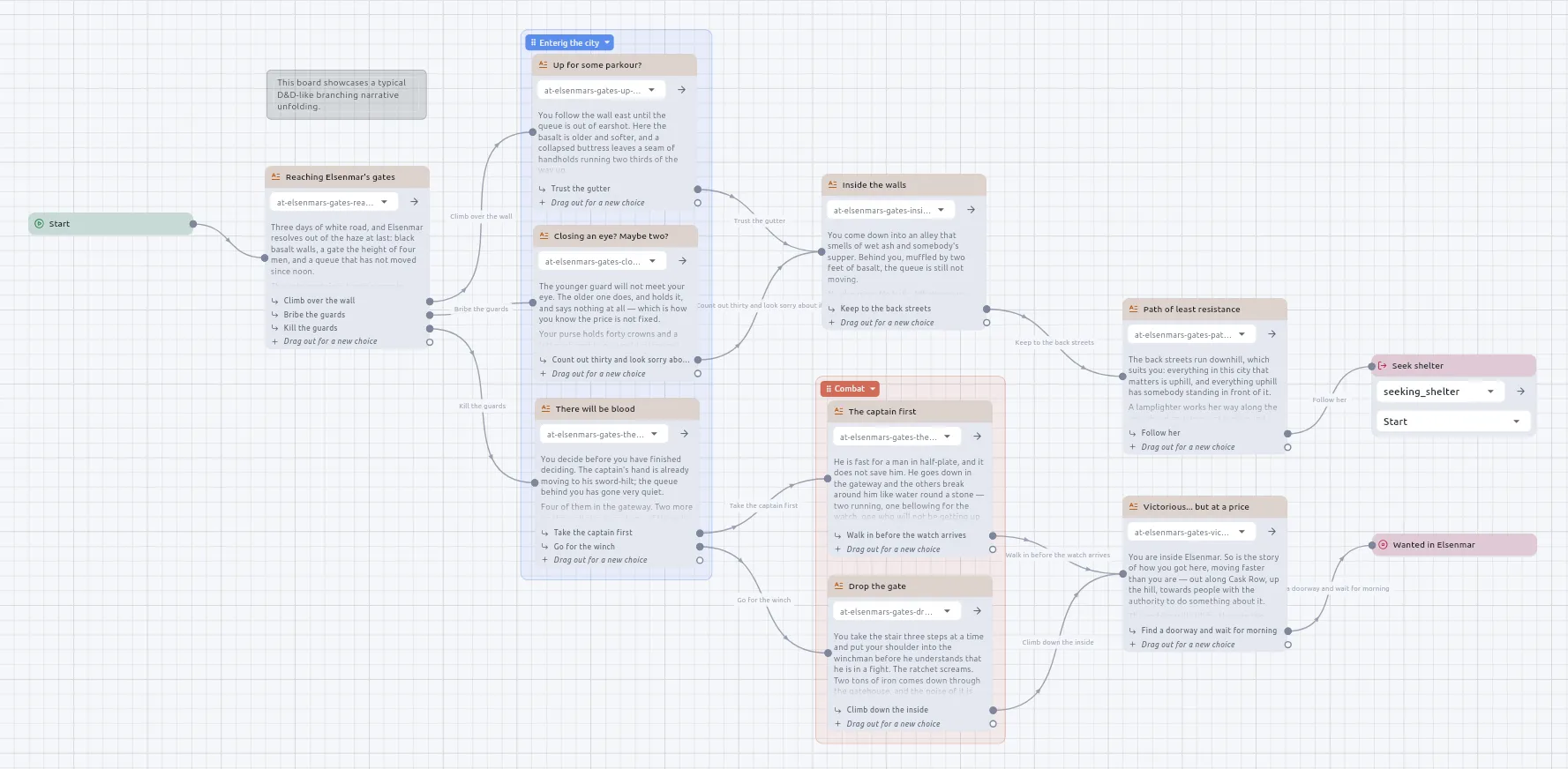
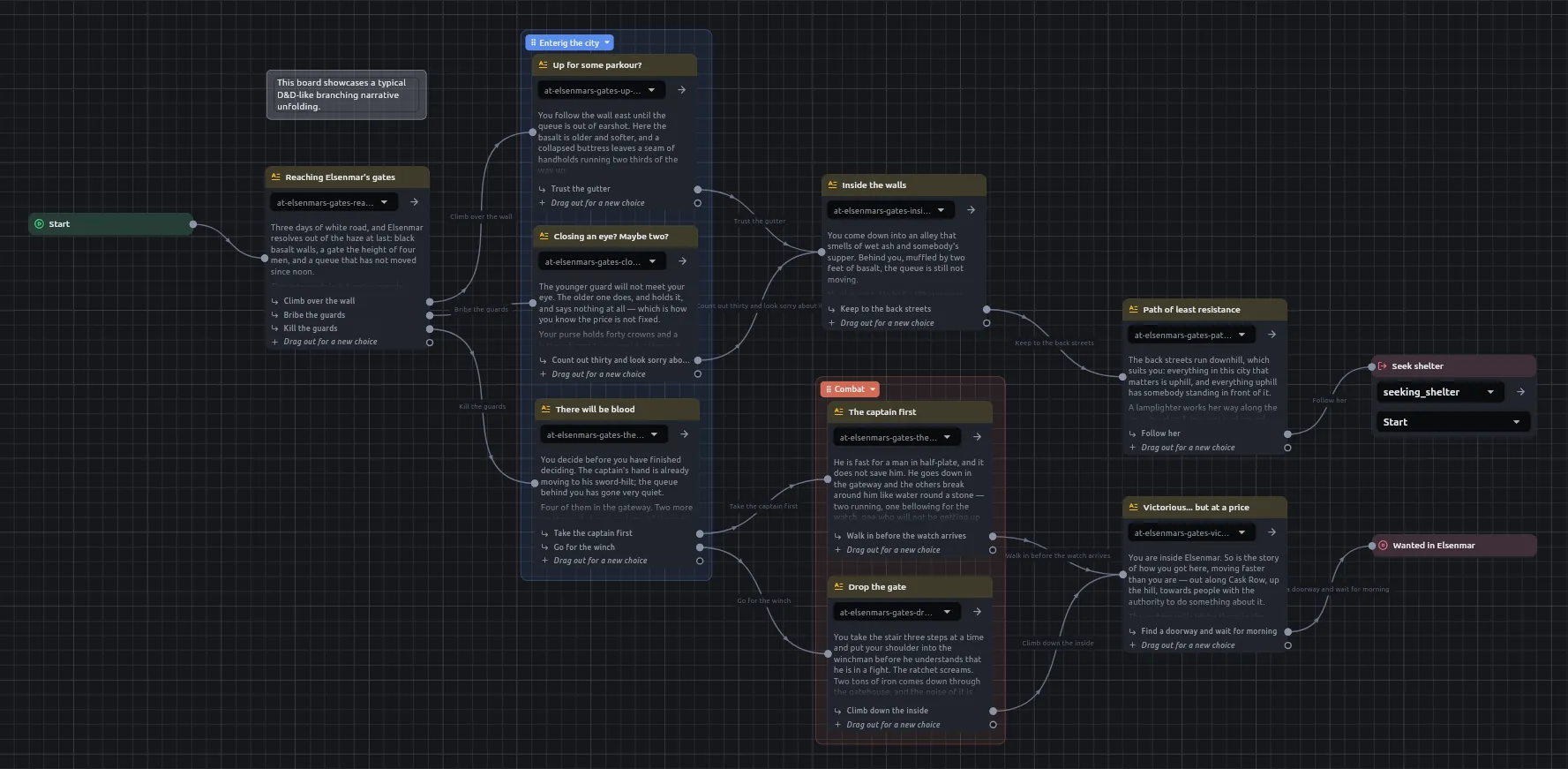
A board is one thread of story: a *.graph.json file drawn as a canvas of
cards and the wires between them. A project has as many boards as it wants —
one per chapter, one per conversation, one per encounter — and a Jump hands
the story from one to the next. A macro is a board a board can call —
a stretch of story written once and used from anywhere — and it has a
section of its own below.
The canvas
Section titled “The canvas”Every board begins with a Start node, and it has exactly one. The Create menu will not offer a second, and a board that somehow has two is refused at Play with both named: several Starts used to mean several stories running one after another in an order decided by where the cards happened to sit, which nobody designed and nothing could tell you about.
Narration nodes hold a passage and grow one output port per choice — wire the last one and a new spare appears beneath it. Click a choice’s row on the card to give it two things: a name, which is the label the card shows so a branch can be found on a wide board, and its words, which are what the reader is offered, in every language the story is being written in. A choice with nothing in the reader’s language falls back to the language the story was written in — an untranslated passage is prose somebody can read past, and an untranslated choice is a button they cannot press. A wire can carry a caption of its own as well; that is an annotation for you, and no reader sees it.
Drop a wire on empty canvas and the Create menu opens there, already wired to whatever you pick. Everything else — Jump, Script, loops, components — is a right-click away. The quickbar along the top has one button, for a passage, because a passage is the one node frequent enough to earn the space.
Every picker of something you made is searchable, and alphabetical. A
Jump’s board, a Component’s component, a Script’s .py, a Narration node’s
passage or soundscape, a State machine’s diagram, a variable on a cvar
node: the menu opens with a search field focused, and typing narrows it by
name or by path, which sits under each name. The one exception is a Jump’s
node picker, which keeps a board’s reading order because that order means
something.
Every card can carry metadata of your own. Right-click it and choose Edit metadata…: a list of names, types and values, and a small tag on the card’s header while there is any. Nothing on the board reads it — it is yours, for a status, a reviewer’s note, a mark for a tool of your own — and it travels with the node into a compiled campaign and to an agent. A copied node arrives with its notes. One thing worth knowing: an older build of the editor re-saving such a board keeps every wire and every field and drops the notes.
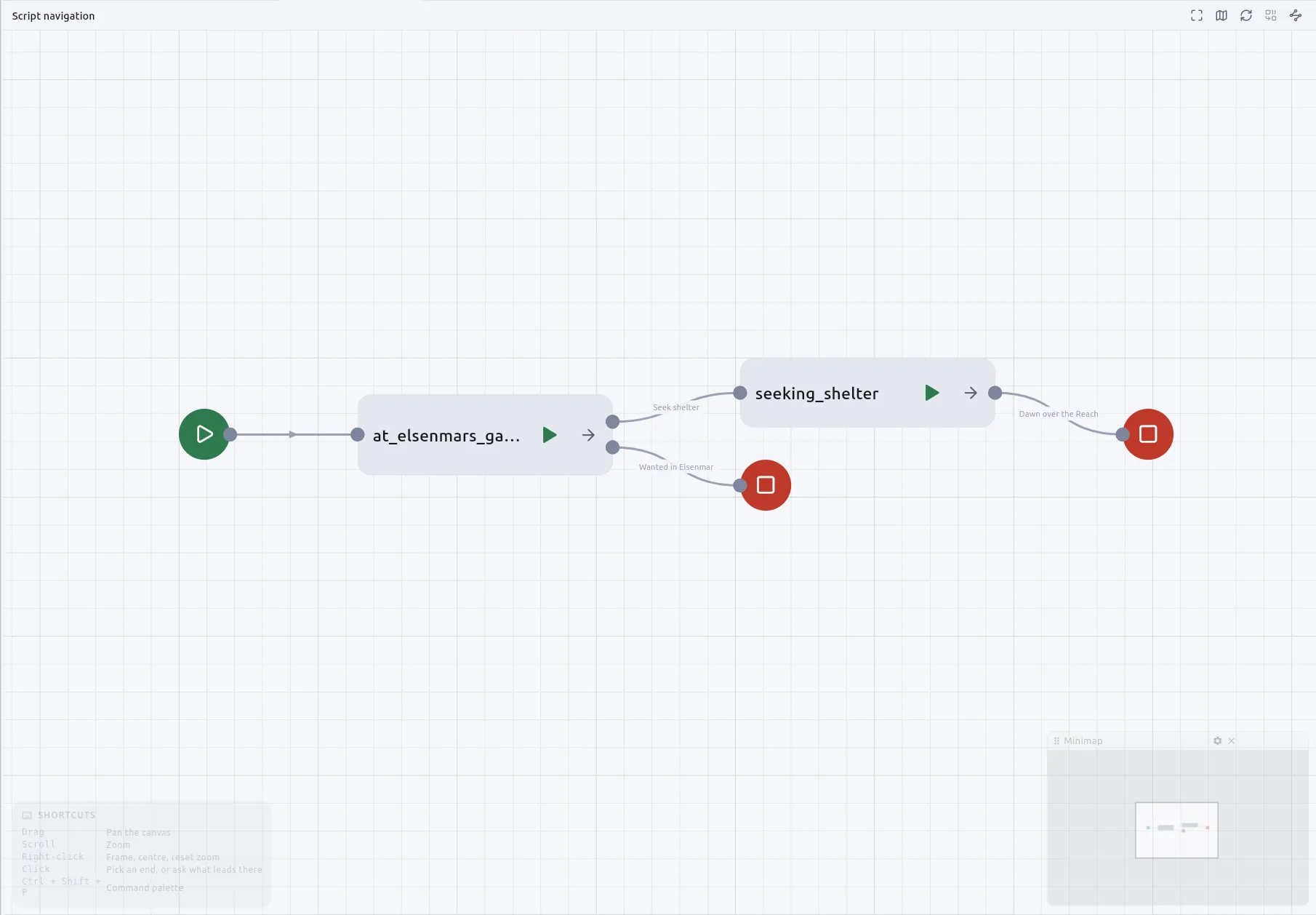
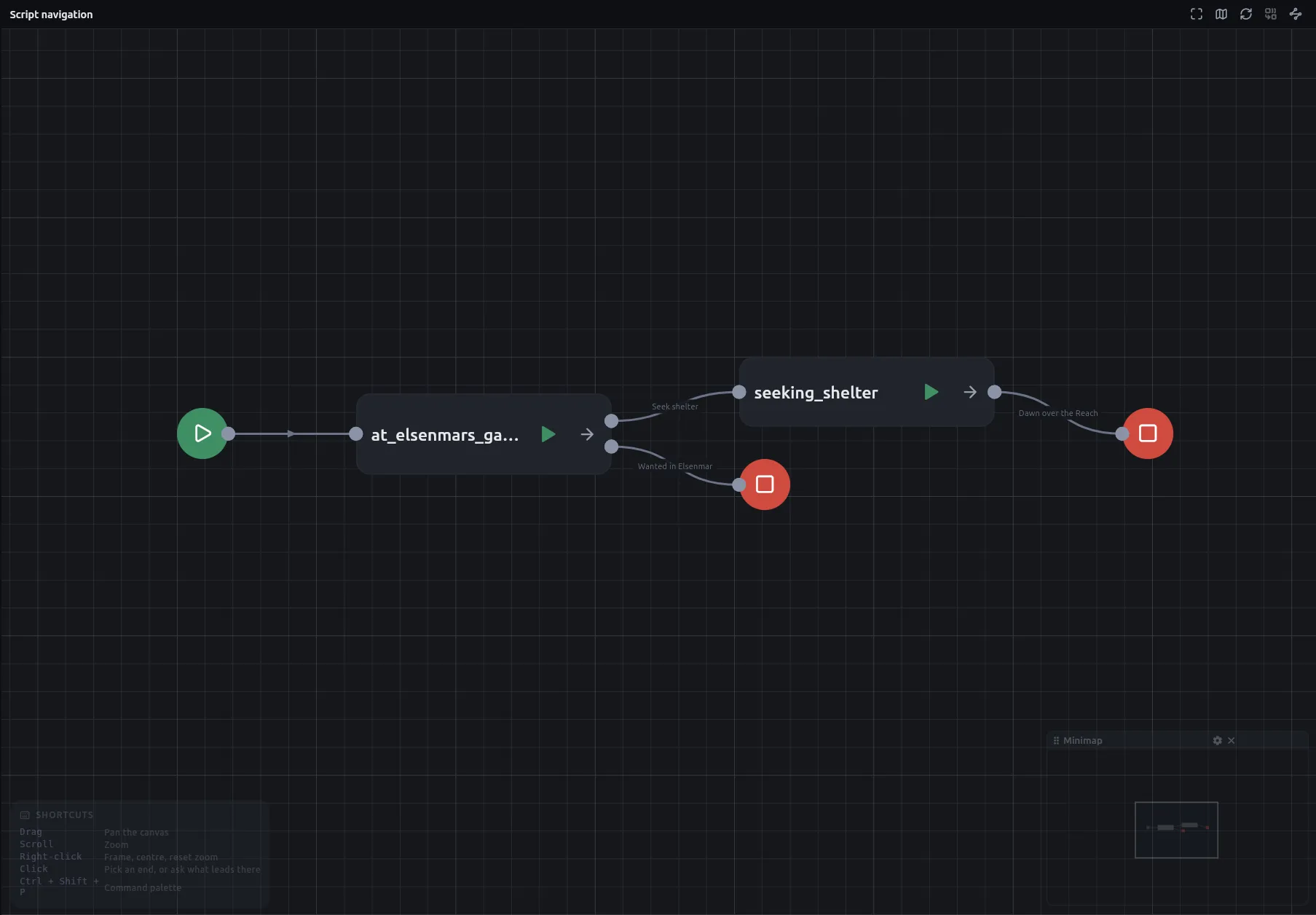
A Jump stores the target board’s catalog id rather than its path, so renaming or moving a board never breaks a link. The arrow on the card opens the board it points at. How the boards hand the story to each other is drawn for you by script navigation, from the left panel’s footer — see Reading a story back.
Cycles are the point, and nothing refuses one.
Two kinds of wire
Section titled “Two kinds of wire”Every port on a card is one of two kinds, and the canvas draws them apart.
Control ports carry the story. A card’s way in is called exec; its ways
out are the choices, the branches, the first and again of a gate, the
completed of a node that merely did something. The story is the path from
Start along control wires: a node takes its turn, hands the flow on through
one of its control outputs, and the next takes its. Two branches that
converge on a card run it twice — there is no waiting for both, because a
branch a condition never takes would wait forever.
Data ports carry values: a number, a name, a list of goblins, the state a machine is in. A data wire is not a step in the story. It is a question the card at its end asks when its turn comes.
The engine — the same one in fl_nodes_v2 and in the runtime that plays an
export — runs the two in opposite directions: control is pushed, data is
pulled. When a node takes its turn and reads a data input, the value is
fetched from the card wired into it, and that card’s inputs from theirs, as
far back as the wires go. A value that is a function of its inputs is worked
out once and reused until an input changes; anything that rolls or reads the
world — a die, a random number, a variable — is evaluated afresh on every
pull.
Every card has control ports, so a card the story never reaches would never
take a turn — and something downstream might still read from it. Before a
story begins the engine walks the data wires back from everything the Start
can reach and finds those cards: they are primed, run once ahead of the
story in dependency order, so that whoever reads them finds the value there.
That is what lets you wire the story and leave the values hanging off it:
a Number into a Set variable, a String into a Component’s name, a Get variable
into an Output — none of them needs an exec wire. Lay out one correct
control path and every value a node on it reads is worked out before it runs.
The one rule that follows: a value that depends on something the story
does must be in the flow after it. A Comparator hanging off a Dice roller
is primed before the story starts, before there is a roll to compare, and
answers for a total that did not exist yet. Wire the roller’s completed
into the Comparator and the Comparator’s into the If, and the comparison
happens when the roll has. The priming is for values that are true before
the story; the flow is for values it makes.
Every kind of node
Section titled “Every kind of node”Grouped the way the Create menu groups them — Flow, Story, Value, Chance, Math and Logic, and the two ends of a macro. Each is described, with what it takes and what it answers, on the nodes reference. The ones a story meets first: Narration for a passage, Jump for another board, End for where a path stops, If and Switch for branching, Dice roller for chance, Component for a character or an item, and Script for Python.
Macros
Section titled “Macros”A macro is a stretch of story you write once and call from anywhere — a
shop, a rest, a skill check with its own three passages. It is a file of its
own, *.macro.graph.json, made from the file tree’s + beside a board, and
it opens on the same canvas with two nodes where a board has its Start and its
Ends:
- Macro In says what the macro takes, described the way an Input node is — double-click it for a name and a type per row — and grows an output per name carrying what the calling board wired in or typed on the card. A macro has exactly one.
- Macro Out says what it answers, the same way, and grows an input per name. Its way in takes any number of wires, so every branch inside the macro can finish at the same way out. Also exactly one.
Everything between the two is the same node set a board has. Drag the file onto a board and a Macro card appears with a port per name, and a field beside every one it takes: wire it or type it, and the wire wins. Press play on the macro’s own tab to read it on its own, with nothing wired in.
A macro is copied into whatever calls it when the campaign is compiled, so calling one twice is two independent copies — a Once gate inside a shop fires once per shop rather than once for the whole story — and a macro cannot call itself. A macro cannot be jumped to and a board cannot be called: a Jump lists boards and a Macro card lists macros. A story can be paused inside one and picked up where it left off, and a line in the play window’s trace about something inside a macro takes you to the card that called it.
Doing several things before a passage
Section titled “Doing several things before a passage”A Do all runs everything wired to it, one branch after another, then
carries on from completed. The rule underneath is that every branch runs to
the end of its wire before the next starts, and a passage does not end a wire
— so a passage on branch two holds branch three until every passage after it
has been read, which looks exactly like a Set that never fired. The card’s
description says so, and the completed port is the way not to have to
think about it: put the jobs on the branches and the story on completed.
Boards written before the port existed grow it the moment they open.
What remembers, and for how long
Section titled “What remembers, and for how long”FlipFlop, Once and State machine remember for the whole playthrough. Leaving the board and coming back, or saving and loading, does not reset them; starting over does. A saved game carries what they remember.
Where the story begins
Section titled “Where the story begins”Where a board begins no longer depends on where its cards are. Script navigation and the merged trace ask the same question the runner does — which node is the Start? — so a route drawn between two passages is the route the story actually takes.