What Ripple Effect is
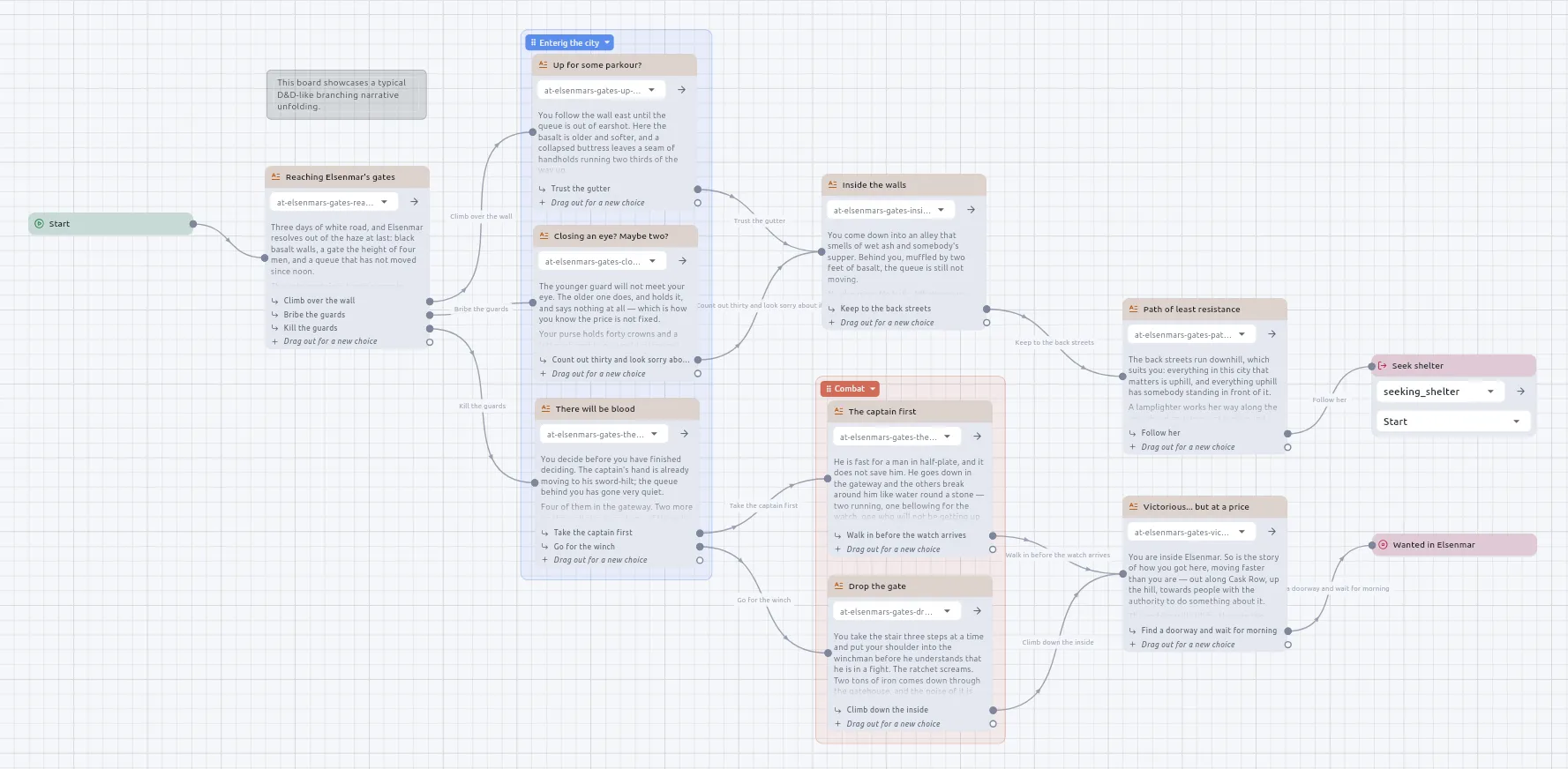
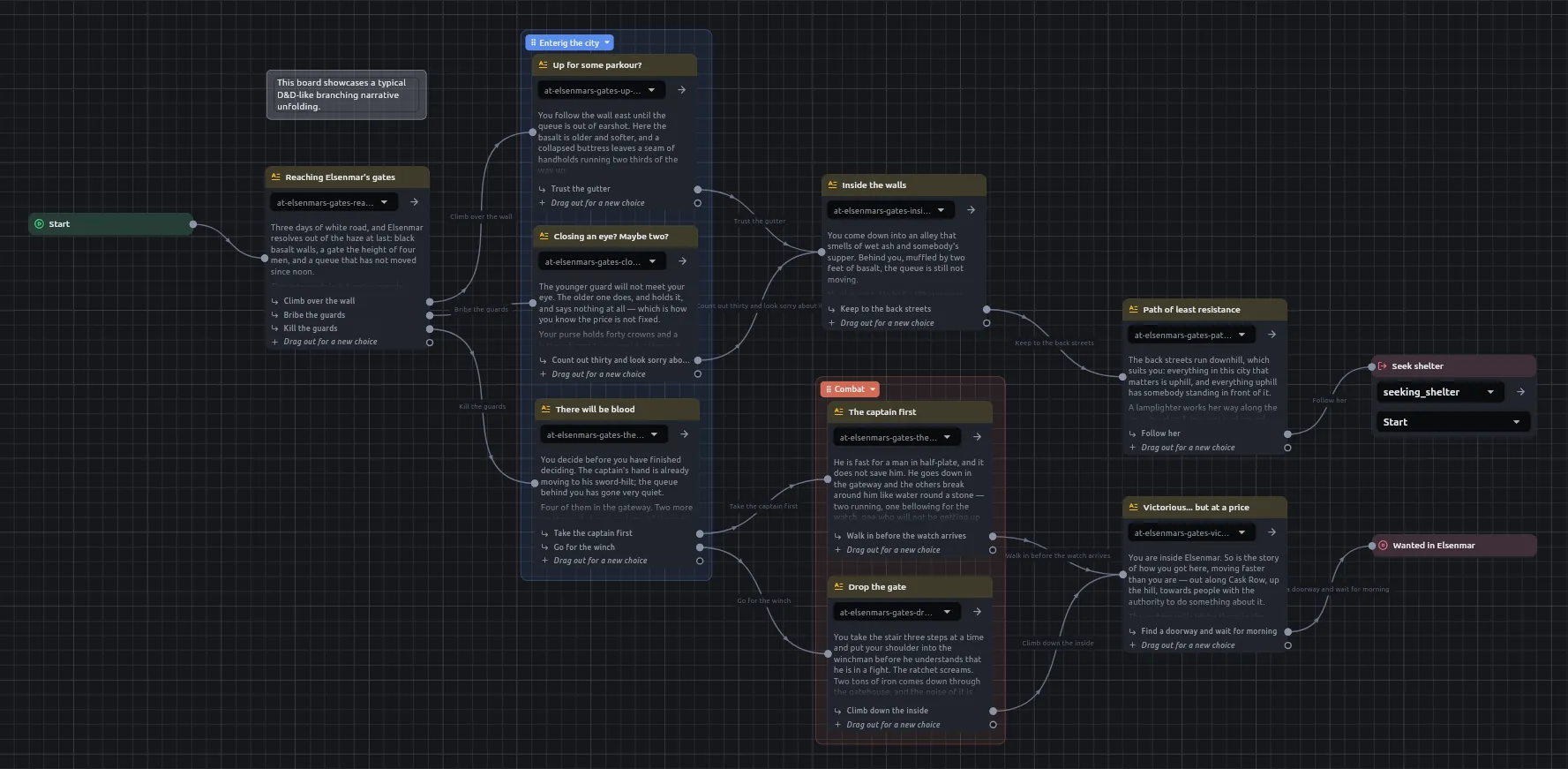
Ripple Effect is a desktop application for writing interactive stories as graphs. You lay passages out on a canvas, wire each choice to what it leads to, and press play to walk the result. Where ArcWeave gives you boards, connections and components in a browser, Ripple Effect gives you the same shapes as a native app over a folder on your own disk — and adds a visual scripting layer around them: loops, conditions, arithmetic, dice, state machines and Python, so a story can compute as well as branch.
It is aimed at tabletop prep, game design documents, quest and dialogue trees, and anything else where the interesting part of a document is the paths through it.
What you do in it
Section titled “What you do in it”- Write on boards. A board is one thread of story — a chapter, a conversation, an encounter — drawn as cards and the wires between them. A passage is a card; a choice is a wire. A Jump hands the story to another board, and a macro is a stretch of story written once and called from anywhere. → Boards and nodes
- Write in more than one language. Every passage is one file per language, and the app tells you which translations have fallen behind. → Passages and languages
- Give the story things to remember. Components are the characters, items and places; console variables are the numbers and flags; state machines are the shapes — a door that is locked, then open. A board reads and changes all three. → Components, Console variables, State machines
- Let it compute. Dice, comparisons, loops and Python — in a node on the board, or inside a sentence, so a passage can say the goblin has 3 hit points left without forking. → Python scripting
- Give it a sound. A passage names a soundscape — music and sound on a timeline, in a file of its own — that stays in force until another replaces it, and a node or a script plays a sound once while the story carries on. → Soundscapes and sounds
- Play it. The play button runs the story from any node, with the same engine an exported campaign runs, and a trace beside it saying what the story did. → Playing a campaign
- Ship it. Export compiles the project into a campaign a runtime plays with no editor near it, or copies the project for a translator. → Exporting
- Keep a history. Git is built in: what changed, side by side, and a conflict shown rather than decided for you. → Version control
- Bring an assistant. The app is an MCP server, so Claude Code, Cursor and the rest can read the project, play it and — once you allow it — write into it. → Working with an AI assistant
Underneath all of it, a project is a folder of ordinary files — Markdown,
JSON, .py — that opens without the app. That is what makes the version
control honest and what lets any other tool read what you wrote. The
workspace overview says exactly what is in the
folder.