Passages and languages
A passage is Markdown. On a board it is a Narration node; on disk it is a
localised passage — a folder the app shows as one file, holding one .md
per language the project has.
Directorychapters/
- the_gates.graph.json
Directoryreaching_the_gates.loc.narr.bdl/
- en-US.md the passage, in the language the story is written in
- it-IT.md its translation
- touch.json when each was last touched, so a clone can tell which is older
One passage in several languages is one document — nothing anybody wants to
open separately. What is on disk stays ordinary Markdown, so a translator
handed the folder can work in any editor and a git diff reads as prose.
Writing
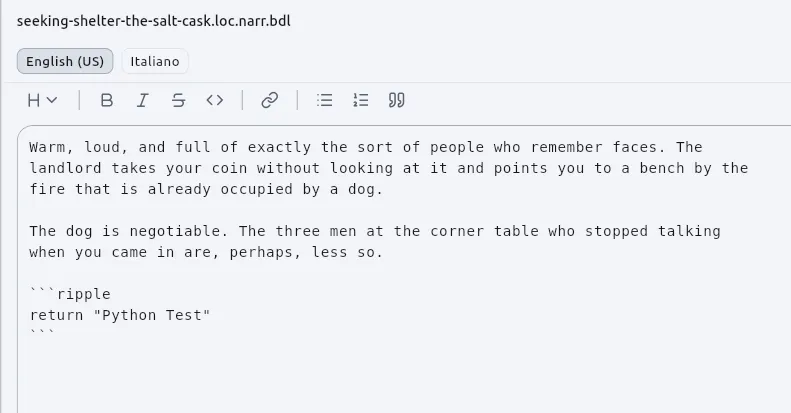
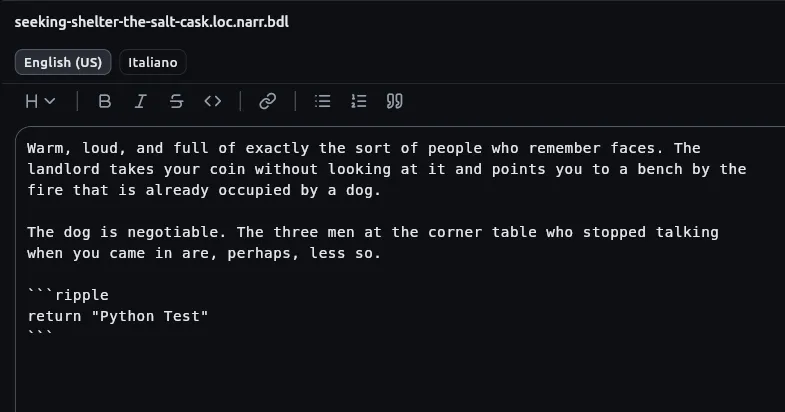
Section titled “Writing”Double-click a Narration node to write in it. The editor is the same Markdown
editor the app uses everywhere: a live render, a formatting toolbar, and image
embeds, local and remote, raster and SVG — drop a file on it and the link
writes itself. A picture picked from outside the project is copied into
.ripple/external/ first, unless importing outside assets is switched off
from the palette, in which case it is linked and Messages says so.
A link the app writes starts with a slash — , measured
from the project’s root the way GitHub reads one — so a passage can be dragged
into a chapter and a folder renamed and the picture still points where it
did. A link written by hand without one goes on meaning what it always meant:
relative to the bundle’s parent folder, the way a file in its place would
be, so  beside chapters/the_gates.graph.json means
art/map.png.
Two places in a passage can hold Python — an inline {{ … }} span and a
fenced ```ripple block — so a sentence can vary instead of forking
into two passages. A passage only reads; see Python
scripting.
The languages
Section titled “The languages”The language a story is written in is chosen when the project is made. The starting point comes from your computer’s settings, but the choice is offered rather than applied on your behalf. The languages it is translated into are chosen in Project settings.
Switching a translation language on puts an empty translation into every bundle. Switching one off deletes nothing: the files stay, the editor keeps showing them marked retired, and readers stop being offered that language. If you want the words gone, you are asked once, on save, and Keep them is the button under your finger — nothing is deleted by clicking through the dialog or dismissing it.
Project settings says what changing Written in will do, which is nothing to your prose: every passage gets an empty file for the new language, everything you have written stays where it is as a translation, and until you carry it across your passages play empty. There is no migration for that yet.
When a translation falls behind
Section titled “When a translation falls behind”The locale chips along the top of a bundle each stand for one language. A dot on a chip means that translation is older than its source. The Messages tab lists every one that has fallen behind, across the whole project.
The app cannot ask the filesystem this question — a git clone sets every
file’s time to the moment of checkout — which is what touch.json is for. It
is written with sorted keys and UTC times so it stays quiet in a diff, and a
conflict between two translators is three lines a person can resolve.
Reading time
Section titled “Reading time”Under every passage: the word count on the left, and on the right a choice of reading pace — slow, average or skimming — with the estimate beside it. It keeps up as you type, and the pace you pick is remembered.
It counts the language you are actually writing in. Fifty-four of them, each with its own reading speed, so a passage in German and the same passage in English come out at about the same length of read even though the word counts differ. Japanese, Chinese, Thai and Khmer are counted by the character, because they are written without spaces between words and counting those by the word gives an answer wrong by a factor of ten. A passage mixing scripts is counted as both.
The estimate says how much to trust it. Seventeen of the languages carry figures from reading studies; the rest are worked out from a close relative, and the tooltip on the estimate says which one you are looking at.
Code does not count as prose: Python snippets and fenced blocks come out before anything is counted, and a link is worth the words you read rather than the length of its URL.
A passage that mixes languages can be counted as one. Off by default, and switched on per project in settings: paragraphs written in a language other than the passage’s own are found and priced at that language’s speed. It is a project setting because whether your prose mixes languages is a fact about the story, and it is off by default because it reads every paragraph after each pause in typing. Short paragraphs are left alone — a language guessed from one line is guessed, not known.
The arithmetic is a separate, open-source package:
dart_read_time,
pure Dart, MIT.